We may earn a commission from purchases through links in this article, at no extra cost to you. How we earn
What matters before choosing
These listings cover sub-5-watt HF QRP operation, from compact uSDX-derived experimenter radios to a factory-integrated Xiegu transceiver.
The comparison uses published listings, stated specifications, bundled hardware, customer ratings, and prices. It does not include physical or hands-on testing.
No verified IC silicon part numbers or ADC bit-resolution details are supplied in the validated material. Treat those specifications as unverified rather than inferred.
- Prioritize band coverage and included power hardware before comparing convenience features.
- Expect antenna efficiency and matching to matter because none of the units includes an internal automatic antenna tuner.
- Treat filtering, harmonic suppression, external attenuation, and thermal behavior as unresolved engineering risks where the listing provides no detailed data.
The shortlist in practical terms
Best for three-band portability
The HAMGEEK unit focuses on 15m, 20m, and 40m with a 5W listing and a compact uSDX-style design.
Best low-cost eight-band reach
The R1.02W covers 80m through 10m and lists 3W to 5W output, but expects external power and antennas.
Best grab-and-go package
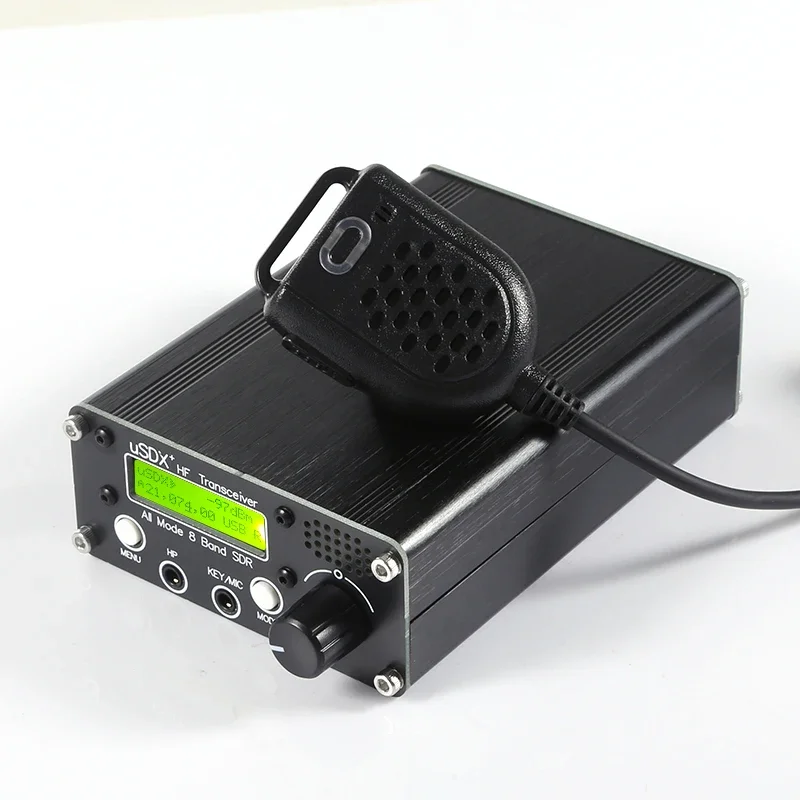
The 2024 USDX USDR includes a battery, charger, and microphone for field use across eight bands.
Best protected portable package
The black-shell USDX USDR adds a protective enclosure, battery, and handheld microphone to eight-band operation.
Best turnkey platform
The Xiegu G106/G106C adds stated DSP, selectable receiver bandwidths, CW keyer functions, CAT control, and digital connectivity.
RF architecture and evidence boundary
Known facts
The uSDX variants are described as using an 8-bit microcontroller, audio processing, single-sideband generation, and a Class-E switching amplifier.
The Xiegu is described as a commercial SDR with dedicated intermediate-frequency signal processing and tuned front-end filtering.
The source does not identify verified IC part numbers, ADC resolution, exact filter insertion loss, harmonic rejection, or external attenuation requirements.
Analysis
Minimal input bandpass preselection may leave direct-conversion uSDX variants more vulnerable to strong-signal overload and desensitization.
Class-E harmonic content depends on the small internal low-pass filter network; crowded clone layouts may provide less margin than a factory-shielded design.
Uncertainties
Seller claims about silicon, ADC resolution, filter performance, harmonic suppression stages, and attenuation should be verified before demanding operation.
No measured thermal data is supplied for internal-battery models during continuous-duty digital transmission.
Technical comparison by declared parameters
| Product | Declared HF coverage | Declared RF output | ADC resolution | Power and included hardware | Front-end and filtering caveat | Listed price and rating |
|---|---|---|---|---|---|---|
| HAMGEEK USDX-CW/USDX-FT8 5W usDX SDR QRP Transceiver QCX-SSB to… | 15m, 20m, 40m | 5W nominal | Not supplied | External power; compact three-band unit | uSDX-style filtering; no external attenuation or harmonic-stage specification | $91.41; 4.6/5 from 44 ratings |
| R1.02W 3-5W USDX+ SDR Transceiver All Mode 8 Band HF Ham Radio… | 80m, 60m, 40m, 30m, 20m, 17m, 15m, 10m | 3W to 5W | Not supplied | External 12V to 13.8V supply; compact unit | Minimal preselection risk; no external attenuation or harmonic-stage specification | $104.40; 4.8/5 from 44 ratings |
| 2024 USDX USDR HF QRP SDR Transceiver SSB/CW Transceiver 8-Band… | 80m through 10m across eight bands | 3W to 5W | Not supplied | Internal rechargeable battery, charger, and microphone | Compact battery case may raise thermal risk; filtering and attenuation details absent | $121.61; 4.8/5 from 18 ratings |
| 5W USDX USDR HF QRP SDR Transceiver SSB/CW Transceiver 8-Band… | 80m through 10m across eight bands | Up to 5W | Not supplied | Internal battery and handheld microphone | uSDX-style filtering; metal case thermal risk and attenuation details absent | $131.32; 4.6/5 from 36 ratings |
| Original XIEGU G106C G106 5W HF Transceiver QRP SDR Transceiver | Standard HF amateur bands | 5W | Not supplied | Factory-integrated transceiver; external accessories required | Tuned front-end filtering is stated; exact suppression and attenuation data absent | $254.11; 5/5 from 14 ratings |



Bottom line
Choose the Xiegu for the most complete factory-oriented operating package; choose a uSDX variant when price, portability, or experimentation outweighs front-end and verification concerns.
The uSDX listings provide useful QRP coverage at lower prices, but their stated minimal preselection, Class-E filtering dependence, and missing silicon details require more system-level care.
Trade-offs and limitations
- All five units are limited to 3W to 5W, so contacts depend heavily on efficient, well-matched antennas or external antenna matching networks.
- None of the units includes an internal automatic antenna tuner.
- Direct-conversion uSDX variants may overload or desensitize near strong shortwave broadcast transmitters because of minimal input bandpass preselection.
- Class-E amplifiers generate harmonics whose suppression depends on the internal low-pass filters; clone layouts may offer less margin.
- Internal-battery models can trap heat during continuous-duty digital modes such as FT8; manage transmit duty cycles carefully.
- No validated specification confirms external attenuation, ADC resolution, exact IC silicon, or complete harmonic suppression stages.
Checks before ordering
- Confirm the exact band setVerify that the listing matches your intended bands, especially the three-band HAMGEEK configuration versus the eight-band models.
- Plan the antenna systemPrepare resonant antennas or an external matching network because no internal automatic antenna tuner is listed.
- Verify electrical detailsAsk the seller for IC part numbers, ADC resolution, filter stages, harmonic suppression, and any external attenuation requirement.
- Check the power packageConfirm whether you need an external 12V to 13.8V supply or prefer an included battery and charger.
- Plan digital-mode duty cyclesUse conservative transmit duty cycles with internal-battery models to limit heat accumulation during FT8.
Common questions
Which model covers the most bands?
The R1.02W and both eight-band USDX USDR listings cover 80m through 10m across eight stated amateur bands.
Which listing is limited to three bands?
The HAMGEEK USDX-CW/USDX-FT8 listing covers 15m, 20m, and 40m.
Do these radios include automatic antenna tuning?
No. The validated article states that none of the five units includes an internal automatic antenna tuner.
Which model is positioned as the factory-integrated option?
The Original XIEGU G106C/G106 is described as a commercial QRP SDR with DSP, selectable receiver filters, CAT control, and digital connectivity.
Are ADC resolution and IC part numbers verified?
No. Those details are not supplied in the validated material, so seller claims should be checked before purchase.